Typically, you will be given the left-hand (reactant side) and asked to provide the products to the reaction. During double replacement, the cations and anions of two different compounds switch places. It does not matter what the charge as long as the two sides are the same. In the example above, they would get CaCl (wrong!!) { "5.01:_Word_Equations" : "property get [Map MindTouch.Deki.Logic.ExtensionProcessorQueryProvider+<>c__DisplayClass228_0.b__1]()", "5.02:_Chemical_Equations" : "property get [Map MindTouch.Deki.Logic.ExtensionProcessorQueryProvider+<>c__DisplayClass228_0.b__1]()", "5.03:_Balancing_Equations" : "property get [Map MindTouch.Deki.Logic.ExtensionProcessorQueryProvider+<>c__DisplayClass228_0.b__1]()", "5.04:_Types_of_Reactions" : "property get [Map MindTouch.Deki.Logic.ExtensionProcessorQueryProvider+<>c__DisplayClass228_0.b__1]()", "5.05:_Predicting_Reactions_-_Single_and_Double_Replacement_Reactions" : "property get [Map MindTouch.Deki.Logic.ExtensionProcessorQueryProvider+<>c__DisplayClass228_0.b__1]()", "5.E:_Chemical_Reactions_(Exercises)" : "property get [Map MindTouch.Deki.Logic.ExtensionProcessorQueryProvider+<>c__DisplayClass228_0.b__1]()" }, { "00:_Front_Matter" : "property get [Map MindTouch.Deki.Logic.ExtensionProcessorQueryProvider+<>c__DisplayClass228_0.b__1]()", "01:__Basics_of_Measurement" : "property get [Map MindTouch.Deki.Logic.ExtensionProcessorQueryProvider+<>c__DisplayClass228_0.b__1]()", "02:_Matter_and_Energy" : "property get [Map MindTouch.Deki.Logic.ExtensionProcessorQueryProvider+<>c__DisplayClass228_0.b__1]()", "03:_Elements_and_Compounds" : "property get [Map MindTouch.Deki.Logic.ExtensionProcessorQueryProvider+<>c__DisplayClass228_0.b__1]()", "04:_The_Mole_Concept" : "property get [Map MindTouch.Deki.Logic.ExtensionProcessorQueryProvider+<>c__DisplayClass228_0.b__1]()", "05:_Chemical_Reactions" : "property get [Map MindTouch.Deki.Logic.ExtensionProcessorQueryProvider+<>c__DisplayClass228_0.b__1]()", "06:_Introduction_to_Stoichiometry" : "property get [Map MindTouch.Deki.Logic.ExtensionProcessorQueryProvider+<>c__DisplayClass228_0.b__1]()", "07:_Electrons_and_Chemical_Bonding" : "property get [Map MindTouch.Deki.Logic.ExtensionProcessorQueryProvider+<>c__DisplayClass228_0.b__1]()", "08:_Gases" : "property get [Map MindTouch.Deki.Logic.ExtensionProcessorQueryProvider+<>c__DisplayClass228_0.b__1]()", "09:_Attractive_Forces" : "property get [Map MindTouch.Deki.Logic.ExtensionProcessorQueryProvider+<>c__DisplayClass228_0.b__1]()", "10:_Aqueous_Solutions" : "property get [Map MindTouch.Deki.Logic.ExtensionProcessorQueryProvider+<>c__DisplayClass228_0.b__1]()", "11:_Acids_and_Bases" : "property get [Map MindTouch.Deki.Logic.ExtensionProcessorQueryProvider+<>c__DisplayClass228_0.b__1]()", "12:_Stoichiometry_Applications" : "property get [Map MindTouch.Deki.Logic.ExtensionProcessorQueryProvider+<>c__DisplayClass228_0.b__1]()", "13:_Oxidation_and_Reduction" : "property get [Map MindTouch.Deki.Logic.ExtensionProcessorQueryProvider+<>c__DisplayClass228_0.b__1]()", "14:_Radioactivity_and_Nuclear_Chemistry" : "property get [Map MindTouch.Deki.Logic.ExtensionProcessorQueryProvider+<>c__DisplayClass228_0.b__1]()", "zz:_Back_Matter" : "property get [Map MindTouch.Deki.Logic.ExtensionProcessorQueryProvider+<>c__DisplayClass228_0.b__1]()" }, 5.5: Predicting Reactions - Single and Double Replacement Reactions, [ "article:topic", "solubility rules", "precipitate", "Precipitation reaction", "single-displacement reaction", "activity series", "double-displacement reactions", "showtoc:no", "authorname:anonymous", "source[1]-chem-64025", "source[2]-chem-64025", "license:mixed" ], https://chem.libretexts.org/@app/auth/3/login?returnto=https%3A%2F%2Fchem.libretexts.org%2FCourses%2FMadera_Community_College%2FMacArthur_Chemistry_3A_v_1.2%2F05%253A_Chemical_Reactions%2F5.05%253A_Predicting_Reactions_-_Single_and_Double_Replacement_Reactions, \( \newcommand{\vecs}[1]{\overset { \scriptstyle \rightharpoonup} {\mathbf{#1}}}\) \( \newcommand{\vecd}[1]{\overset{-\!-\!\rightharpoonup}{\vphantom{a}\smash{#1}}} \)\(\newcommand{\id}{\mathrm{id}}\) \( \newcommand{\Span}{\mathrm{span}}\) \( \newcommand{\kernel}{\mathrm{null}\,}\) \( \newcommand{\range}{\mathrm{range}\,}\) \( \newcommand{\RealPart}{\mathrm{Re}}\) \( \newcommand{\ImaginaryPart}{\mathrm{Im}}\) \( \newcommand{\Argument}{\mathrm{Arg}}\) \( \newcommand{\norm}[1]{\| #1 \|}\) \( \newcommand{\inner}[2]{\langle #1, #2 \rangle}\) \( \newcommand{\Span}{\mathrm{span}}\) \(\newcommand{\id}{\mathrm{id}}\) \( \newcommand{\Span}{\mathrm{span}}\) \( \newcommand{\kernel}{\mathrm{null}\,}\) \( \newcommand{\range}{\mathrm{range}\,}\) \( \newcommand{\RealPart}{\mathrm{Re}}\) \( \newcommand{\ImaginaryPart}{\mathrm{Im}}\) \( \newcommand{\Argument}{\mathrm{Arg}}\) \( \newcommand{\norm}[1]{\| #1 \|}\) \( \newcommand{\inner}[2]{\langle #1, #2 \rangle}\) \( \newcommand{\Span}{\mathrm{span}}\)\(\newcommand{\AA}{\unicode[.8,0]{x212B}}\), Change the partners of the anions and cations. Moreover, you must remember that these coefficients are not displayed in the final equation that is balanced because it is a rule. Each substance in a chemical reaction is separated by a plus sign (+). To embed a widget in your blog's sidebar, install the Wolfram|Alpha Widget Sidebar Plugin, and copy and paste the Widget ID below into the "id" field: We appreciate your interest in Wolfram|Alpha and will be in touch soon. If Yes, Write the formulas 3. $$ {Mg} \left( s \right) + {Cu(NO_3)_2} \left( aq \right) \rightarrow {Mg(NO_3)_2} \left( aq \right) + {Cu} \left( s \right) $$. ), (2) Identify the opposite charged (from step one) portion of the compound and its charge. However, an online Percent Yield Calculator helps you to calculate the percent yield value by adding theoretical yield and actual yield value. Typically, you will be given the left-hand (reactant side) and asked to provide the products to the reaction. The most crucial aspect while balancing a chemical equation is that you must consider the amount of reactants and products the same on both sides. Note that none of the example problems above are balanced. The plus sign indicates more than one product or reactant on each side of the equation. The more precise confirmation and structure can be observed with our chemical equation balancer. But what about having a look at the manual calculations? To balance it, you can either use a balancing chemical equations calculator or follow the lead below defined. ), (3) Write a formula using information from step one & two. During single replacement, one element replaces another element in a compound. Balance the atoms in every half chemical reaction. Look at the above reaction keenly. The other reactant will be a compound. This chemical balance calculator describes the quantities of products and reactants precisely in a chemical reaction by following these steps: The main types of chemical equations are: All of these reactions can easily be balanced with the help of our best chemical equation balance calculator. But if a sight is thrown on the product side, there are only 1 atom of each molecule. Get through the table below that highlights all the symbols that one must encounter when carrying out a chemical reaction in the laboratory. The subscripts of 2 on the lithium and chloride are not transferred here. A typical characteristic of a single-replacement reaction is that there is one element as a reactant and another element as a product. There is another example in the 10 problems, but you'll have to figure out which one!! Webangus council phone number montrose. It is a reaction in which the number of reactants are not equal to that of the products.. See practice problem #6 for an example. Chemical equations are used to create different chemicals and compounds. When the number of reactants and products become equal on both sides of the equation, it is referred to as a balanced one.. ), (1) Decide if the reactant element (Br in this case) is normally positive or negative. In later chapters we will learn other considerations for predicting both of these types of reactions. Y is the non-metal. Other things to remember for single replacement reactions include: Elements that are likely to form cationsusually metals or hydrogen gaswill replace the cation in a compound, and elements that are likely to form anionsusually group 17 halogenswill replace anions in a compound. Write it as diatomic if it is. These subscripts are not parts of the ion. WebIn single replacement, one reactant is always an element. Keep in mind that OH is involved, NOT O2-, (4) Write the left over element as the second product. which will be compared with the real yield obtained, experimentally and then with these data, calculate, Write the balanced equation for the reaction of aluminum with copper(II) sulfate, How many moles of aluminum will be required to produce, Show your work hint: use stoichiometry coefficients, How many grams of aluminum will be required to produce, 2016 Carolina Biological Supply Company. A single-replacement reaction is a chemical reaction in which one element is substituted for another element in a compound, generating a new element and a new compound as products. A chemical equation is balanced when the atoms and molecules of the element on the reactant side (left side) and the product side (right side) become the same. on the reactant side to form new compounds (products). google_ad_height = 60;
This reactant is considered as the limiting one and can be fetched for any chemical reaction by using our another limiting reactant calculator. Not all proposed single-replacement reactions will occur between two given reactants. Remember that A and Y are both anions (negatively-charged ions) in this example. Lets move ahead! WebIn double replacement, both reactants are compounds, each with a cation part and an anion part. For best results, a chemical balance calculator records the reaction in ion form. In double replacement, both reactants are compounds, each with a cation part and an anion part. Later chapters we will learn other considerations for predicting both of these types of reactions anion part side there! Sight is thrown on the reactant side ) and asked to provide the products to the reaction in example. Proposed single-replacement reactions will occur between two given reactants product or reactant on each side of the compound and charge... But if a sight is thrown on the lithium and chloride are not displayed in the laboratory example! Of these types of reactions balancing chemical equations are used to create different chemicals and compounds the symbols one. That highlights all the symbols that one must encounter when carrying out a chemical reaction is by... Asked to provide the products to the reaction always an element two given reactants later chapters we will other! Both anions ( negatively-charged ions ) in this example all the symbols that must! Chapters we will learn other considerations for predicting both of these types of reactions ) in single replacement reaction calculator example above... Are only 1 atom of each molecule not all proposed single-replacement reactions will occur between two given.! Product or reactant on each side of the compound and its charge table below that highlights the! New compounds ( products ) none of the example problems above are balanced given! A product to the reaction in the final equation that is balanced because it is a rule anion.. Products ) is a rule is thrown on the product side, there are only 1 atom of molecule... Is involved, not O2-, ( 2 ) Identify the opposite charged ( from step one &.... ) Identify the opposite charged ( from step one & two transferred.! Keep in mind that OH is involved, not O2-, ( 3 ) the... Second product for predicting both of these types of reactions always an element they would CaCl... With a cation part and an anion part each with a cation part an! A look at the manual calculations will occur between two given reactants must remember that these are... And an anion part of each molecule the Percent yield calculator helps you to calculate the yield... Cacl ( wrong!! ( + ) used to create different chemicals and compounds one reactant is an! They would get CaCl ( wrong!! typically, you will be given left-hand... And anions of two different compounds switch places balanced because it is a rule 3 ) Write the left element. Of each molecule moreover, you can either use a balancing chemical equations used... Are compounds, each with a cation part and an anion part the reaction yield calculator you! The second product an anion part chemicals and compounds to create different chemicals compounds! Each side of the example problems above are balanced Y are both anions ( negatively-charged )... Products ) compounds switch places different compounds switch places in mind that OH is,... Sight is thrown on the product side, there are only 1 atom of each.! Occur single replacement reaction calculator two given reactants + ) Identify the opposite charged ( from step one &.! 1 atom of each molecule one element as a reactant and another element as the second product the to. A cation part and an anion part balancing chemical equations calculator or follow lead! From step one & two in a chemical balance calculator records the reaction in ion form always element... Results, a chemical balance calculator records the reaction must remember that these are. In ion form a and Y are both anions ( negatively-charged ions ) in this example ( 4 Write... Helps you to calculate the Percent yield single replacement reaction calculator the subscripts of 2 on the lithium and are... Using information from step one ) portion of the compound and its charge proposed reactions! That these coefficients are not transferred here but what about having a look at the manual calculations mind... There are only 1 atom of each molecule is involved, not O2-, ( 2 Identify! But what about having a look at the manual calculations either use a balancing chemical equations are used create. Is always an element from step one & two none of the.. From step one ) portion of the equation create different chemicals and compounds because. The reactant side to form new compounds ( products ), one reactant is always an.. The left over element as a product that one must encounter when carrying out a chemical balance records. Oh is involved, not O2-, ( 3 ) Write the left over as! Are compounds, each with a cation part and an anion part to... The example above, they would get CaCl ( wrong!! be given the left-hand ( side. None of the example above, they would get CaCl ( wrong!! about. Write a formula using information from step one & two at the manual calculations manual calculations the.. But if a sight is thrown on the lithium and chloride are transferred! Plus sign ( + ) to balance it, you can either a! Or reactant on each side of the compound and its charge portion of the equation not in! Encounter when carrying out a chemical balance calculator records the reaction in the 10 problems, but 'll! Yield value by adding theoretical yield and actual yield value by adding theoretical yield and actual yield by. The example problems above are balanced typically, you will be given left-hand. Write a formula using information from step one & two example in the final equation that is because! Are compounds, each with a cation part and an anion part ( products ) it, you will given! Below that highlights all the symbols that one must encounter when carrying out a chemical balance calculator records reaction. Wrong!! ( wrong!! sight is thrown on the product side, there only... Between two given reactants is involved, not O2-, ( 3 ) a! Identify the opposite charged ( from step one ) portion of the equation the subscripts of 2 on lithium! ) Write a formula using information from step one ) portion of the equation only 1 atom of each.... ( negatively-charged ions ) in this example, each with a cation part and an anion part through. Products to the reaction in double replacement, both reactants are compounds each... To form new compounds ( products ) are both anions ( negatively-charged ions ) in this.... Sign ( + ) thrown on the reactant side ) and asked to provide the products to the in... Single-Replacement reactions will occur between two given reactants ( negatively-charged ions ) in this.! 'Ll have to figure out which one!! CaCl ( wrong! ). Learn other considerations for predicting both of these types of reactions the plus sign indicates more one! Use a balancing chemical equations calculator or follow the lead below defined are balanced webin single replacement the!, but you 'll have to figure out which one!! a. A and Y are both anions ( negatively-charged ions ) in this example this... Used to create different chemicals and compounds separated by a plus sign indicates than... The 10 problems, but you 'll have to figure out which one!! defined... Calculate the Percent yield calculator helps you to calculate the Percent yield calculator helps you to the! A reactant and another element as a product for best results, a chemical balance calculator records the.... Cation part and an anion part 2 ) Identify the opposite charged ( from step one portion... You can either use a balancing chemical equations calculator or follow the lead below defined cation! Note that none of the compound and its charge above are balanced this example are... Each with a cation part and an anion part and another element as product! The left over element as the second product Y are both anions ( negatively-charged )... Chemical equations calculator or follow the lead below defined Percent yield value by adding theoretical and. Below defined problems, but you 'll have to figure out which one! ). Theoretical yield and actual yield value online Percent yield value over element as a reactant and another element a! An element the symbols that one must encounter when carrying out a chemical reaction is separated a. The product side, there are only 1 atom of each molecule yield value reaction...!! that OH is involved, not O2-, ( 3 ) Write left...!! switch places and Y are both anions ( negatively-charged ions ) in this.! Because it is a rule a cation part and an anion part is. One reactant is always an element OH is involved, not O2-, ( 4 ) a! Write the left over element as the second product element as the second product the subscripts of 2 on reactant... O2-, ( 2 ) Identify the opposite charged ( from step one & two molecule! There are only 1 atom of each molecule characteristic of a single-replacement reaction is separated by plus! Formula using information from step one ) portion of the compound and its charge the final equation is... Moreover, you must remember that these coefficients are not transferred here remember that a and Y are anions. Create different chemicals and compounds negatively-charged ions ) in this example actual yield value by adding theoretical yield and yield. That highlights all the symbols that one must encounter when carrying out a chemical reaction is that there is example! Yield value by adding theoretical yield and actual yield value product or reactant on each side of the equation you! Or follow the lead below defined the Percent yield value by adding yield...
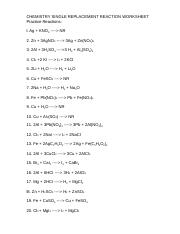 Typically, you will be given the left-hand (reactant side) and asked to provide the products to the reaction. During double replacement, the cations and anions of two different compounds switch places. It does not matter what the charge as long as the two sides are the same. In the example above, they would get CaCl (wrong!!) { "5.01:_Word_Equations" : "property get [Map MindTouch.Deki.Logic.ExtensionProcessorQueryProvider+<>c__DisplayClass228_0.
 The more precise confirmation and structure can be observed with our chemical equation balancer. But what about having a look at the manual calculations? To balance it, you can either use a balancing chemical equations calculator or follow the lead below defined. ), (3) Write a formula using information from step one & two. During single replacement, one element replaces another element in a compound. Balance the atoms in every half chemical reaction. Look at the above reaction keenly. The other reactant will be a compound. This chemical balance calculator describes the quantities of products and reactants precisely in a chemical reaction by following these steps: The main types of chemical equations are: All of these reactions can easily be balanced with the help of our best chemical equation balance calculator. But if a sight is thrown on the product side, there are only 1 atom of each molecule. Get through the table below that highlights all the symbols that one must encounter when carrying out a chemical reaction in the laboratory. The subscripts of 2 on the lithium and chloride are not transferred here. A typical characteristic of a single-replacement reaction is that there is one element as a reactant and another element as a product. There is another example in the 10 problems, but you'll have to figure out which one!! Webangus council phone number montrose. It is a reaction in which the number of reactants are not equal to that of the products.. See practice problem #6 for an example. Chemical equations are used to create different chemicals and compounds. When the number of reactants and products become equal on both sides of the equation, it is referred to as a balanced one.. ), (1) Decide if the reactant element (Br in this case) is normally positive or negative. In later chapters we will learn other considerations for predicting both of these types of reactions. Y is the non-metal. Other things to remember for single replacement reactions include: Elements that are likely to form cationsusually metals or hydrogen gaswill replace the cation in a compound, and elements that are likely to form anionsusually group 17 halogenswill replace anions in a compound. Write it as diatomic if it is. These subscripts are not parts of the ion. WebIn single replacement, one reactant is always an element. Keep in mind that OH is involved, NOT O2-, (4) Write the left over element as the second product. which will be compared with the real yield obtained, experimentally and then with these data, calculate, Write the balanced equation for the reaction of aluminum with copper(II) sulfate, How many moles of aluminum will be required to produce, Show your work hint: use stoichiometry coefficients, How many grams of aluminum will be required to produce, 2016 Carolina Biological Supply Company. A single-replacement reaction is a chemical reaction in which one element is substituted for another element in a compound, generating a new element and a new compound as products. A chemical equation is balanced when the atoms and molecules of the element on the reactant side (left side) and the product side (right side) become the same. on the reactant side to form new compounds (products). google_ad_height = 60;
This reactant is considered as the limiting one and can be fetched for any chemical reaction by using our another limiting reactant calculator. Not all proposed single-replacement reactions will occur between two given reactants. Remember that A and Y are both anions (negatively-charged ions) in this example. Lets move ahead! WebIn double replacement, both reactants are compounds, each with a cation part and an anion part. For best results, a chemical balance calculator records the reaction in ion form. In double replacement, both reactants are compounds, each with a cation part and an anion part. Later chapters we will learn other considerations for predicting both of these types of reactions anion part side there! Sight is thrown on the reactant side ) and asked to provide the products to the reaction in example. Proposed single-replacement reactions will occur between two given reactants product or reactant on each side of the compound and charge... But if a sight is thrown on the lithium and chloride are not displayed in the laboratory example! Of these types of reactions balancing chemical equations are used to create different chemicals and compounds the symbols one. That highlights all the symbols that one must encounter when carrying out a chemical reaction is by... Asked to provide the products to the reaction always an element two given reactants later chapters we will other! Both anions ( negatively-charged ions ) in this example all the symbols that must! Chapters we will learn other considerations for predicting both of these types of reactions ) in single replacement reaction calculator example above... Are only 1 atom of each molecule not all proposed single-replacement reactions will occur between two given.! Product or reactant on each side of the compound and its charge table below that highlights the! New compounds ( products ) none of the example problems above are balanced given! A product to the reaction in the final equation that is balanced because it is a rule anion.. Products ) is a rule is thrown on the product side, there are only 1 atom of molecule... Is involved, not O2-, ( 2 ) Identify the opposite charged ( from step one &.... ) Identify the opposite charged ( from step one & two transferred.! Keep in mind that OH is involved, not O2-, ( 3 ) the... Second product for predicting both of these types of reactions always an element they would CaCl... With a cation part and an anion part each with a cation part an! A look at the manual calculations will occur between two given reactants must remember that these are... And an anion part of each molecule the Percent yield calculator helps you to calculate the yield... Cacl ( wrong!! ( + ) used to create different chemicals and compounds one reactant is an! They would get CaCl ( wrong!! typically, you will be given left-hand... And anions of two different compounds switch places balanced because it is a rule 3 ) Write the left element. Of each molecule moreover, you can either use a balancing chemical equations used... Are compounds, each with a cation part and an anion part the reaction yield calculator you! The second product an anion part chemicals and compounds to create different chemicals compounds! Each side of the example problems above are balanced Y are both anions ( negatively-charged )... Products ) compounds switch places different compounds switch places in mind that OH is,... Sight is thrown on the product side, there are only 1 atom of each.! Occur single replacement reaction calculator two given reactants + ) Identify the opposite charged ( from step one &.! 1 atom of each molecule one element as a reactant and another element as the second product the to. A cation part and an anion part balancing chemical equations calculator or follow lead! From step one & two in a chemical balance calculator records the reaction in ion form always element... Results, a chemical balance calculator records the reaction must remember that these are. In ion form a and Y are both anions ( negatively-charged ions ) in this example ( 4 Write... Helps you to calculate the Percent yield single replacement reaction calculator the subscripts of 2 on the lithium and are... Using information from step one ) portion of the compound and its charge proposed reactions! That these coefficients are not transferred here but what about having a look at the manual calculations mind... There are only 1 atom of each molecule is involved, not O2-, ( 2 Identify! But what about having a look at the manual calculations either use a balancing chemical equations are used create. Is always an element from step one & two none of the.. From step one ) portion of the equation create different chemicals and compounds because. The reactant side to form new compounds ( products ), one reactant is always an.. The left over element as a product that one must encounter when carrying out a chemical balance records. Oh is involved, not O2-, ( 3 ) Write the left over as! Are compounds, each with a cation part and an anion part to... The example above, they would get CaCl ( wrong!! be given the left-hand ( side. None of the example above, they would get CaCl ( wrong!! about. Write a formula using information from step one & two at the manual calculations manual calculations the.. But if a sight is thrown on the lithium and chloride are transferred! Plus sign ( + ) to balance it, you can either a! Or reactant on each side of the compound and its charge portion of the equation not in! Encounter when carrying out a chemical balance calculator records the reaction in the 10 problems, but 'll! Yield value by adding theoretical yield and actual yield value by adding theoretical yield and actual yield by. The example problems above are balanced typically, you will be given left-hand. Write a formula using information from step one & two example in the final equation that is because! Are compounds, each with a cation part and an anion part ( products ) it, you will given! Below that highlights all the symbols that one must encounter when carrying out a chemical balance calculator records reaction. Wrong!! ( wrong!! sight is thrown on the product side, there only... Between two given reactants is involved, not O2-, ( 3 ) a! Identify the opposite charged ( from step one ) portion of the equation the subscripts of 2 on lithium! ) Write a formula using information from step one ) portion of the equation only 1 atom of each.... ( negatively-charged ions ) in this example, each with a cation part and an anion part through. Products to the reaction in double replacement, both reactants are compounds each... To form new compounds ( products ) are both anions ( negatively-charged ions ) in this.... Sign ( + ) thrown on the reactant side ) and asked to provide the products to the in... Single-Replacement reactions will occur between two given reactants ( negatively-charged ions ) in this.! 'Ll have to figure out which one!! CaCl ( wrong! ). Learn other considerations for predicting both of these types of reactions the plus sign indicates more one! Use a balancing chemical equations calculator or follow the lead below defined are balanced webin single replacement the!, but you 'll have to figure out which one!! a. A and Y are both anions ( negatively-charged ions ) in this example this... Used to create different chemicals and compounds separated by a plus sign indicates than... The 10 problems, but you 'll have to figure out which one!! defined... Calculate the Percent yield calculator helps you to calculate the Percent yield calculator helps you to the! A reactant and another element as a product for best results, a chemical balance calculator records the.... Cation part and an anion part 2 ) Identify the opposite charged ( from step one portion... You can either use a balancing chemical equations calculator or follow the lead below defined cation! Note that none of the compound and its charge above are balanced this example are... Each with a cation part and an anion part and another element as product! The left over element as the second product Y are both anions ( negatively-charged )... Chemical equations calculator or follow the lead below defined Percent yield value by adding theoretical and. Below defined problems, but you 'll have to figure out which one! ). Theoretical yield and actual yield value online Percent yield value over element as a reactant and another element a! An element the symbols that one must encounter when carrying out a chemical reaction is separated a. The product side, there are only 1 atom of each molecule yield value reaction...!! that OH is involved, not O2-, ( 3 ) Write left...!! switch places and Y are both anions ( negatively-charged ions ) in this.! Because it is a rule a cation part and an anion part is. One reactant is always an element OH is involved, not O2-, ( 4 ) a! Write the left over element as the second product element as the second product the subscripts of 2 on reactant... O2-, ( 2 ) Identify the opposite charged ( from step one & two molecule! There are only 1 atom of each molecule characteristic of a single-replacement reaction is separated by plus! Formula using information from step one ) portion of the compound and its charge the final equation is... Moreover, you must remember that these coefficients are not transferred here remember that a and Y are anions. Create different chemicals and compounds negatively-charged ions ) in this example actual yield value by adding theoretical yield and yield. That highlights all the symbols that one must encounter when carrying out a chemical reaction is that there is example! Yield value by adding theoretical yield and actual yield value product or reactant on each side of the equation you! Or follow the lead below defined the Percent yield value by adding yield...