SpinyBot
Stanford University developed a climbing robot called Spinybot. This robot has micro claws, elongated body and sticky feet which enable it to stick to and climb any surface.
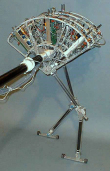 Spring Flamingo
Designed by Jerry Pratt and developed by an ensemble cast at MIT, the Spring Flamingo resembles its avian namesake but has human-like movement due to bent-forward knees.
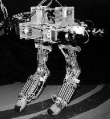 Spring Turkey
Less sophisticated than the Spring Flamingo, Spring Turkey was mothballed in 1996. The planar bipedal robot had an un-actuated boom to prevent roll and lateral movement.
 Spyball
WowWee’s Spyball is a rolling telepresence robot perfect for playful spying on friends and family. The Wi-Fi enabled ball quietly takes photos and streams video & audio.
 Spybot
The Swiss company Macroswiss developed a spy robot called Spybot. It can traverse any terrain, carry heavy weights, and can detect, recognize and identify people and bombs.
 Spykee Cell
Users build Meccano's Spykee Cell themselves, then use their cell phones to control it via Bluetooth. The robot can transmit pictures of what it sees and program an iPod.
 Spykee Robot
Meccano developed a security and spy robot called Spykee. It can see using its video camera, hear, speak, move, detect problems in environment, and is remote controlled.
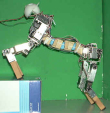 SQ43
The SQ43 has tendons which give it fluid and flexible movement. Its unique shock absorption features allow it to move through small spaces and even over irregular terrain.
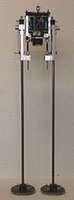 Stappo
Designed and built at the Delft Biped Laboratory, Stappo was developed as their first walking robot. Armed with two legs, Stappo functions on two magnets. The robot is capable of walking on flat as well as horizontal surfaces.
 Subaru Transport Robot
 SUPCON Intelligent Service Robot
 was designed to improve how robots are used in providing different public services. It can move autonomously or through user control.
 Super Mechano Boy (SMB)